PROVEN ACROSS GEO • MEO • HIGH-RELIABILITY LEO

Large-Format LSE Cells

The same LCO chemistry and physical construction that has delivered over 5.0 MWh flown in space with this large-format family — now in Gen 4 with meaningful performance gains while preserving full heritage.

5+ MWh
Flown with this large-format family & LCO chemistry
262+
Satellites powered across all orbits
20+ Years
Longest demonstrated on-orbit (Thaicom 4 / IPSTAR)
Zero
Cell failures on major programs
Company data as of early 2026; includes ongoing programs and backlog.
ONE PLATFORM. MULTIPLE GENERATIONS.

The same construction.
The same heritage.
Measurable improvement.

GS Yuasa’s large-format LSE cells use the same fundamental chemistry, materials, wound-prismatic construction, and manufacturing processes in Kyoto across generations and case sizes. This deliberate continuity means programs benefit from decades of real flight heritage while accessing incremental performance gains in Gen 4.

GEN 3 — PROVEN FOUNDATION

Introduced 2009. Strong adoption across GEO, MEO, LEO, and human-rated missions. The cells that helped deliver the first 5+ MWh in space with this chemistry and form factor.

GEN 4 — EVOLUTION, NOT REVOLUTION

~10% capacity increase with similar retention characteristics. Lower DCR at BOL. Improved energy density while maintaining the identical physical construction that protects full heritage qualification.

Both generations are available in energy-optimized (standard for GEO) and power-optimized electrode configurations. The only difference is coating thickness — everything else is the same trusted design.

THE FAMILY

Large-Format LSE Cell Lineup

Multiple capacities in the same proven elliptic-cylindrical form factor. Gen 4 delivers measurable gains while preserving the exact physical construction and heritage of Gen 3.
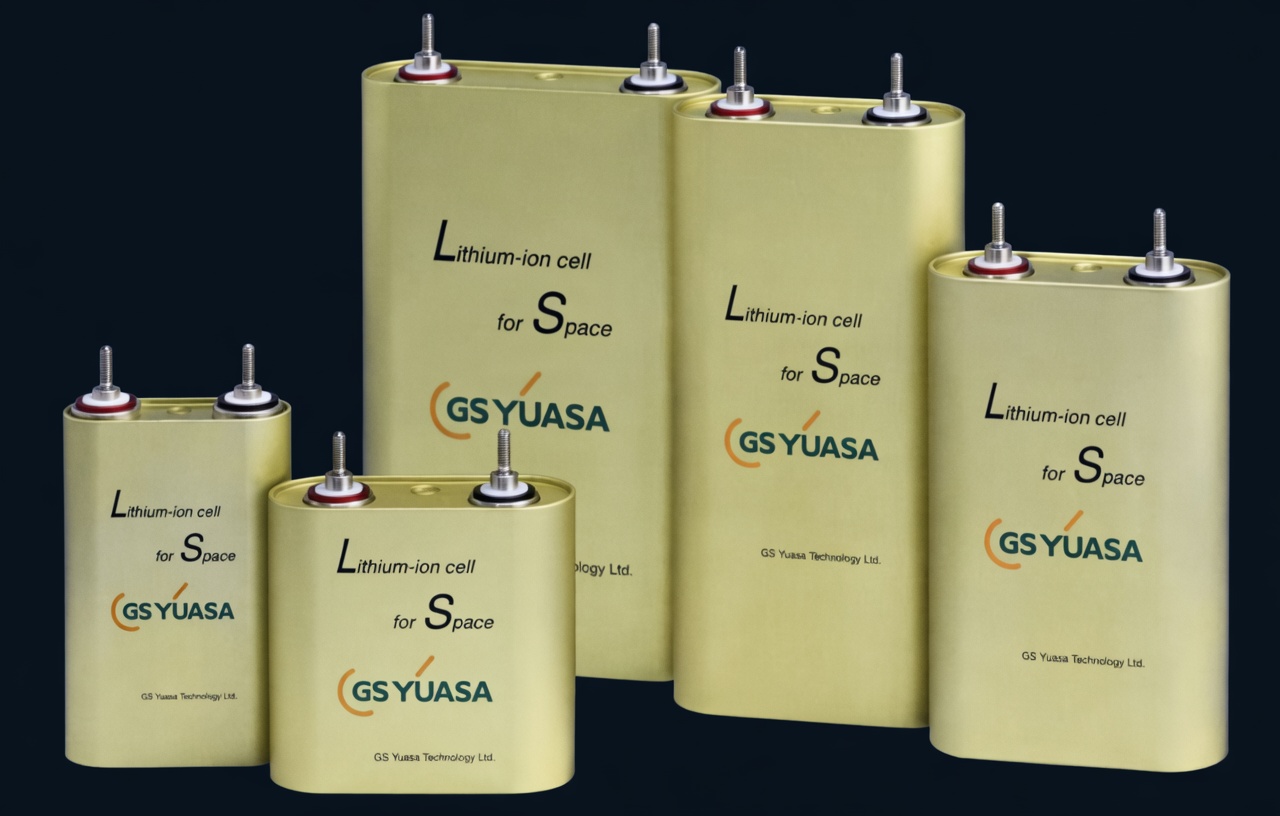
GS Yuasa large-format LSE cell family lineup

Large-format LSE cells — over 5.0 MWh deployed in space with this form factor and LCO chemistry (zero failures on major programs).

Gen 3 vs Gen 4 — Key Improvements

Data drawn from GS Yuasa SPW presentations
Parameter Gen 3 Gen 4 Impact
Physical Construction Proven since prior generations Identical to Gen 3 Full heritage carry-over. No requalification of mechanical design.
Capacity (example) LSE145 ≈ 145 Ah LSE160 ≈ 160 Ah ~10% increase while maintaining retention characteristics
Energy Density Baseline Improved Higher Wh/kg and Wh/L in the same envelope
DCR Behavior Excellent long-term stability Lower DCR at BOL Lower resistance at beginning of life in the same proven mechanical envelope and qualification path
Cycle Life Performance Proven in 15+ year GEO & high-DoD LEO Exceeding typical 15-year GEO profiles in testing Strong results in 100%, 80%, 60% GEO and 40%/25% LEO profiles
Energy Optimized
← Swipe horizontally to view all columns →
Parameter LSE110
Gen 3
LSE122*
Gen 4
LSE145
Gen 3
LSE160
Gen 4
LSE190
Gen 3
LSE205
Gen 4
Chemistry Generation Gen 3 Gen 4 Gen 3 Gen 4 Gen 3 Gen 4
Capacity, BOL (Ah) 122 132 161 176 205 225
Capacity, Nameplate (Ah) 110 122 145 160 190 205
Nominal Voltage (V) 3.70 3.72 3.70 3.72 3.70 3.72
Mass (kg) 2.77 2.85 3.55 3.69 4.59 4.78
Dimensions (mm, L×W×H) 130 × 50 × 208 130 × 50 × 263 165 × 50 × 263
Specific Energy, BOL (Wh/kg) 163 175 168 180 165 175
Nominal Discharge Rate (A) 110 122 145 160 190 205
Nominal Charge Rate (A) 55 61 72.5 80 85 100
Power Optimized
← Swipe horizontally to view all columns →
Parameter LSE51
Gen 3
LSE102
Gen 3
LSE112
Gen 4
LSE134
Gen 3
LSE147
Gen 4
Chemistry Generation Gen 3 Gen 3 Gen 4 Gen 3 Gen 4
Capacity, BOL (Ah) 57 114 124 148 160
Capacity, Nameplate (Ah) 51 102 112 134 147
Nominal Voltage (V) 3.75 3.75 3.75 3.75 3.75
Mass (kg) 1.52 2.77 2.85 3.53 3.67
Dimensions (mm, L×W×H) 130 × 50 × 131 130 × 50 × 216 130 × 50 × 271
Specific Energy, BOL (Wh/kg) 139 152 163 155 163
Nominal Discharge Rate (A) 51 102 112 134 147
Nominal Charge Rate (A) 25 51 56 67 73.5
Contact us for detailed data sheets and mission-specific modeling. Radiation and thermal performance data are available to U.S. persons and eligible entities under NDA.
THE DIFFERENTIATOR PROGRAMS ACTUALLY FEEL

Advanced Life & Performance Modeling

We don’t just sell cells. We help you right-size the entire energy storage solution using tools and data built on decades of real flight experience across this exact chemistry and form factor.

What our modeling delivers

  • Accurate end-of-life performance predictions based on your specific duty cycle, temperature profile, and DoD requirements
  • Optimized cell selection and battery architecture — avoiding the mass and cost penalty of conservative worst-case oversizing
  • Realistic margin management using the same methodology applied to 262+ satellites and the longest-running missions
  • Consistent modeling approach from large GEO cells (LSE190, LSE160) down to LSE12x — one data heritage across the entire family

Real mission example approach

We routinely take actual spacecraft telemetry or predicted load profiles and run detailed life and performance models. This produces clear trade studies showing exactly how different cell configurations and sizing decisions affect mass, volume, and end-of-life margin.

Typical outputs we provide:
Capacity fade curves for your exact DoD & temperature
DCR at BOL and mission-life performance projections
Recommended cell type + parallel/series configuration
Margin vs. oversizing comparison with quantified mass savings

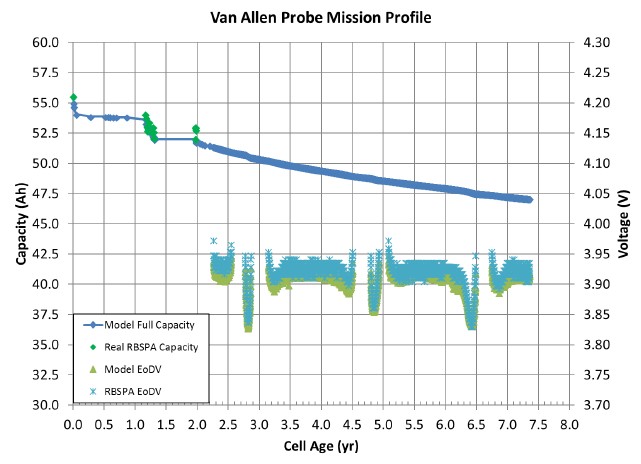
See the on-orbit validated example from the APL Van Allen Probes mission in the section below.

CONCRETE MISSION VALIDATION

Example: APL Van Allen Probes (RBSPA) Mission Profile

The model accurately predicts the following three key metrics for determining a cell’s useful life (validated on the APL Van Allen Probes mission):
  • Full Charge Capacity
  • On-Orbit Capacity
  • End of Discharge Voltage

Full presentation (including methodology and additional validation cases) available in the Resources hub.

Van Allen Probe Mission Profile graph cropped from original SPW 2024 slide 24

Van Allen Probe (RBSPA) mission profile — GS Yuasa model predictions (lines) vs. actual on-orbit data (markers) over 8 years. The model tracks flight data with high fidelity using simple orbital inputs provided by APL. Source: GS Yuasa SPW 2024, Slide 24.

FLIGHT PROVEN AT SCALE

Heritage That Actually Matters

Large-format LSE cells are not a new product line — they are the chemistry and construction GS Yuasa has flown for decades. The milestones below reflect real programs, not marketing claims.

Landmark Achievements

INDUSTRY FIRST

First manufacturer of large-format Li-ion cells to surpass 5.0 MWh flown — achieved with LSE190 cells on Northrop Grumman Cygnus.

LONGEST DEMONSTRATED LIFE

Thaicom 4 — over 20 years on-orbit with LSE cells, demonstrating the platform’s calendar and cycle life credentials.

HUMAN SPACEFLIGHT & CRS

Multiple Cygnus CRS missions and ISS battery replacements powered by LSE large-format cells.

DEEP SPACE

Support for NASA’s Dragonfly mission using LSE147 Gen 4 cells.

Recent Momentum (Gen 4)

MARCH 2025
First Gen 4 flight delivery

EaglePicher Technologies took delivery of Generation 4 LSE112 cells — the first use of GS Yuasa’s Gen 4 space-optimized chemistry in a North American flight program.

ONGOING
Program deliveries

Multiple shipments of both Gen 3 and Gen 4 large-format cells to EaglePicher and other primes for demanding programs.

FOR EPS ENGINEERS ON LONG-HORIZON PROGRAMS

Why Leading Programs Choose LSE Cells

01
Full Heritage Carry-Over

Gen 4 uses the identical physical construction as Gen 3. All the qualification, flight data, and long-term material history transfers directly.

02
Configuration Control & Longevity

15+ years of documented material source control. Strong supplier relationships. Purpose-built for space — not adapted COTS cells.

03
Right-Sizing, Not Oversizing

Proprietary modeling tools turn your actual mission profile into optimized cell selection and architecture — saving mass and cost while maintaining high confidence.

READY TO START YOUR ANALYSIS?

Speak with a power systems engineer

We can provide mission-specific modeling, detailed cycle life data for your DoD and temperature profiles, qualification packages, and right-sizing support for GEO, MEO, or high-reliability LEO programs.

Key documents available: Gen 4 Life & Performance (SPW2023), Qualification of Gen 4 Cells (SPW2021), Large Format Qualification History (NBW2011), and full heritage overview.
Technical content on this site is intended for U.S. persons and entities eligible to receive export-controlled data under ITAR and EAR.